Anyone who has gone through the process of applying for a job in the Gulf knows there is a lot more involved than just signing an offer letter and booking a flight. Somewhere in the middle of the paperwork sits a mandatory health screening, and understanding how it works ahead of time can save you a genuine amount of stress and wasted time.
This piece breaks down what the Gcc countries medical requirement actually involves, why it exists, and what you should expect when your turn comes around.
The Basic Idea Behind This Requirement
The six nations that make up the Gulf Cooperation Council, Saudi Arabia, the UAE, Qatar, Kuwait, Bahrain, and Oman, each require foreign workers to pass a standardized health screening before their work visa can be finalized. This is not a new policy, and it is not unique to this region either. Many countries around the world impose some form of health screening on incoming workers or immigrants, but given the sheer scale of the migrant workforce in the Gulf, the system here is particularly well established and tightly regulated.
The screening focuses on detecting a specific set of communicable diseases, including tuberculosis, HIV, and hepatitis B and C, along with a general assessment of physical fitness. The reasoning is fairly practical: with millions of workers entering these countries every year across construction, healthcare, hospitality, and domestic work, screening at the point of origin helps manage public health risk before it becomes a larger issue.
Where the Testing Actually Happens
Rather than allowing any hospital or clinic to conduct these exams, Gulf countries maintain a network of officially authorized medical centers spread across major labor-sending nations such as India, Pakistan, Bangladesh, Nepal, Sri Lanka, and the Philippines. These centers follow standardized protocols so that a result issued in one city carries the same weight and credibility as a result issued in another, regardless of which Gulf country the applicant is headed to.
This is an important detail that trips up a lot of first-time applicants. A checkup from a well-regarded private hospital back home, no matter how comprehensive, will not be accepted unless that hospital is specifically on the approved list for this purpose.
How the Process Typically Unfolds
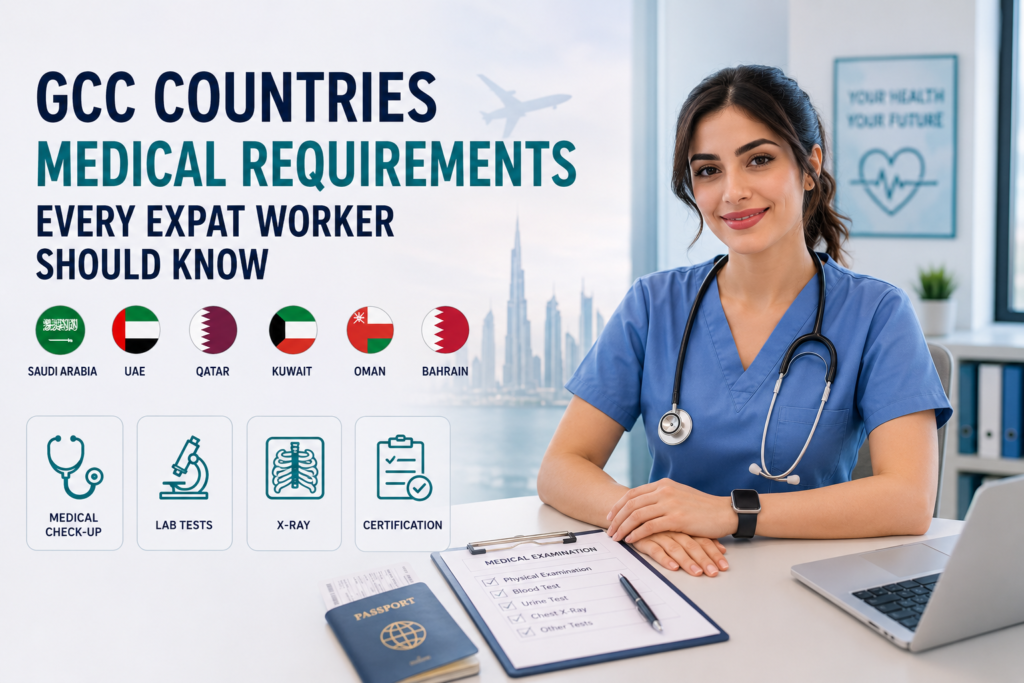
The general Gcc countries medical screening process starts with booking an appointment at one of these approved centers, usually through an online portal rather than a walk-in visit. Once booked, the applicant shows up with their passport, a passport photograph, and their visa or employment reference details. The exam itself includes a chest X-ray, blood tests, a urine sample, and a basic physical checkup covering vision, hearing, and general fitness.
Most people are done within an hour, and the experience is comparable to a routine annual health checkup rather than anything invasive or particularly uncomfortable. Results typically take three to seven working days, after which they are transmitted electronically to the relevant visa processing system.
Slight Differences Between Destination Countries
While the core requirements are broadly similar across all six nations, there are small variations depending on where you are headed and what type of job you are taking up. Some countries have additional screening requirements for certain professions, particularly in food handling or healthcare roles, while others may require supplementary tests depending on the applicant’s country of origin. It is worth checking the specific requirements tied to your destination and job category rather than assuming every Gulf country follows an identical checklist.
Validity Periods and Why Timing Matters
One detail that catches a lot of applicants off guard is that these medical certificates are only valid for a limited period, generally around three months from the date of issue. Visa processing does not always move at a predictable pace, and if there are delays on the employer’s end or with government processing, your certificate might expire before you actually travel, forcing you to repeat the entire exam.
Because of this, it makes sense to time your appointment based on a realistic estimate of your visa timeline rather than rushing to complete it the moment you accept a job offer. Booking too early can be just as inconvenient as booking too late.
Employers and recruitment agencies dealing with these visas regularly are usually a good source of guidance on timing, since they have seen how long processing tends to take for specific job categories and destination countries, and they can often tell you roughly when to schedule your appointment for the best outcome.
Where to Start the Process
For applicants trying to understand exactly how this fits together for their specific situation, https://gamca-medical.co.in/ provides a straightforward way to check approved centers, book appointments, and understand documentation requirements specific to each destination country, which removes a lot of the guesswork that otherwise comes from relying entirely on word of mouth from other applicants.
A Few Final Thoughts
This health screening is simply a formal, regulated part of moving to the Gulf for work, not a hurdle designed to complicate your plans. Once you understand which center to use, what documents to bring, and how the timing fits into your broader visa process, it becomes a fairly routine step rather than a source of anxiety. Most workers who have been through this describe the actual appointment as far less stressful than the uncertainty leading up to it, and with a bit of planning, there is no reason your experience should be any different.