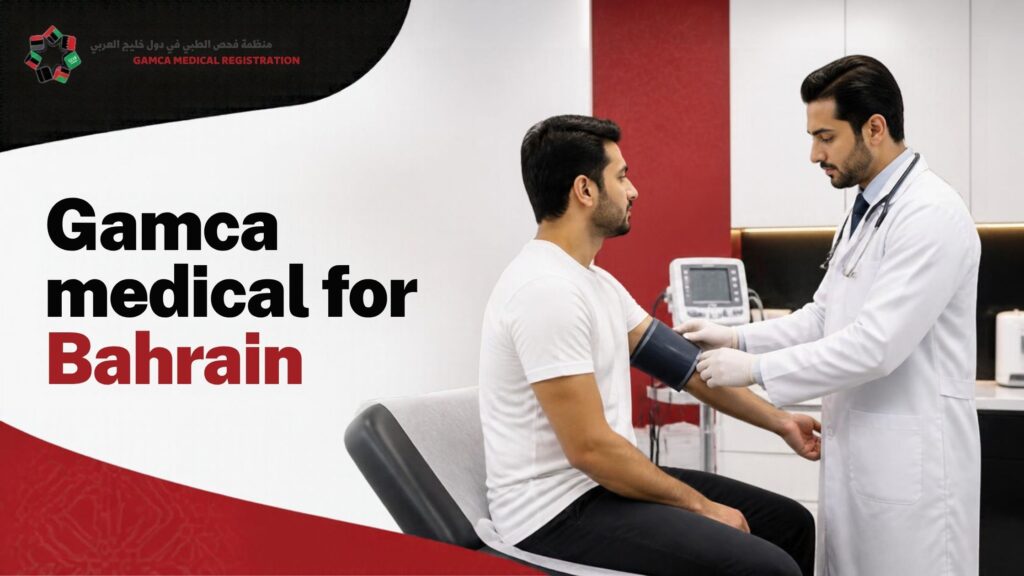
Bahrain is small on the map, but it’s busy when it comes to work. Banks in Manama, factories in Sitra, hotels in Muharraq, hospitals, malls and construction sites all hire from India. Many of those offers come with the same line in the email: complete your medical test and send the report.
If that’s where you are right now, this guide on Gamca medical for Bahrain is for you. We’ll cover why the test exists, what is checked, how the booking works, and the small things that decide whether your paperwork moves in a week or drags for a month.
Why Bahrain requires a medical from overseas workers
Every country that welcomes foreign workers wants to protect public health and make sure new arrivals can do the job they’re hired for. In the Gulf, the usual approach is a pre-departure medical done at an approved centre in the worker’s home country. It saves time and money on both sides.
For Bahrain, your employer usually deals with the work permit through the labour authorities, while you handle the medical. The two tracks meet later at the visa stage. If your medical report is missing or invalid, the file gets stuck, and the person who feels it most is you.
Who needs to take it
Workers heading to Bahrain on an employment visa are the main group. That includes skilled professionals, technicians, drivers, sales staff, cleaners, security personnel and domestic workers. If you’re travelling on another visa type, the rule may differ, so confirm it with your sponsor rather than assuming.
A useful habit is to ask your recruiter three questions up front. Which country is listed on my visa? What job title is written? Do you want a fresh medical or will an older one work? Those three answers prevent most mix-ups.
What the medical includes
The test is a standard Gulf health screening. A doctor checks general health, heart, lungs, abdomen, skin, eyes and ears, and asks about your medical history and current medicines. Blood samples are collected and tested for infections like HIV and hepatitis, among others, and for general indicators such as blood sugar. Urine is tested too. A chest X-ray looks for tuberculosis or other lung conditions. Women can be asked to take a pregnancy test.
Nothing about it is dramatic. If you’ve ever had a routine health check for a job in India, the experience is similar, just more formal and with a stricter record-keeping process.
Booking, step by step
The process for Gamca medical for Bahrain begins online. You open the official booking page, create an application, and fill in your personal and passport details. Spellings must match your passport exactly. Next you select Bahrain as the destination country, choose your profession, and pick an approved centre and date. You pay the fee online and print the appointment slip.
On the day, you carry your passport, the slip, two photographs and photocopies. You’ll register at the front desk, give samples, get your chest X-ray and meet the doctor. The visit usually takes a few hours. Your result is then uploaded to the system, where your recruiter or sponsor can see it.
Book early in the month if you can. Slots in busy cities fill quickly, and last-minute cancellations are rare.
Validity and how to time it with your visa
Medical reports come with a validity period, commonly about three months, though rules can change, so double-check with your recruiter. The practical point is simple: don’t take the medical months before your visa is ready.
A good rule of thumb is to book the test once your employer confirms that the visa process has started or is about to start. If the visa gets delayed for some reason, ask whether your report will still be accepted. If not, plan for a repeat and budget for it.
What can go wrong, and how to handle it
Most applicants walk through without trouble. A few run into delays, and the reasons are usually boring. A typo in the passport number. A profession on the slip that doesn’t match the visa. A missed appointment because someone read the date wrong. Slow uploads from a very busy centre.
Then there are medical flags. Raised blood pressure, high blood sugar, an unclear X-ray or a positive infection screen can lead to a hold or an unfit result. In some situations a repeat test or a specialist review sorts it out. If you receive a flag, ask for the reason in simple terms, speak to a doctor you trust, and tell your recruiter early so that they can plan around it.
Beware of shortcuts and middlemen
Wherever there is a deadline, someone sells a shortcut. You may hear offers of “same-day fit” results, appointments without registering, or someone else taking the test for you. Please don’t. Beyond being dishonest, these tricks can get your application rejected and your name flagged.
Book directly using the official system, keep your own copy of the slip and receipt, and never hand your original passport to someone you don’t know. If you want help from an agent, choose one with a visible office and a track record.
Getting ready for the day
Preparation is simple. Sleep well. Drink water. Skip alcohol and heavy fried meals the day before. Carry your regular medicines and prescriptions. Wear loose, comfortable clothes without metal. Reach the centre with time to spare, because queues form early.
Pack a small folder with the passport, slip, receipt, photographs and photocopies, and add a pen. Phone charged, ID handy, patience in your pocket.
Life after the medical
Once your report is cleared, the visa stage moves forward. After you arrive in Bahrain, your employer will usually handle residency formalities and may ask for further documents or checks as per local rules. Keep both digital and printed copies of your report with you.
Think of the medical as the first of several small checkpoints. None of them are hard, but each rewards the person who is organised.
Sectors that hire from India
Knowing where the jobs are helps you understand why the medical matters. Bahrain’s financial sector hires accountants, analysts and support staff. The industrial belt takes on technicians, welders, electricians and plant operators. Hotels and restaurants look for chefs, waiters, housekeeping and front-desk teams. Hospitals and clinics need nurses and lab technicians. Retail chains and malls hire sales staff and supervisors.
Each sector has slightly different expectations around health and fitness. A chef or a hospital worker may be checked more closely for infections. A driver or a machine operator may face stricter vision standards. Ask your employer whether your role has any particular requirement.
Costs and budgeting
The official fee is only part of the spend. Add travel to the centre, a meal, photocopies and photographs. If you’re from a smaller town, a night’s stay near the centre may be sensible. Setting aside a small buffer helps if you need to repeat a sample or come back for a doctor’s review.
Ask your employer whether they’ll reimburse the cost, and get the answer in writing. Some deduct it from the first salary, others pay in full, and a few ask you to cover it yourself. Knowing this early avoids awkward conversations later.
Questions to put to your recruiter
Before you book anything, ask a few direct questions. Which exact job title is on my visa? Is there a preferred centre? When do you need the report by? Will the report remain valid until my visa is stamped? Who will check that the result is visible in the system?
A good recruiter answers these without fuss. If someone avoids the questions, gets irritated or pushes you to pay quickly, treat that as a warning. Your career move deserves a partner who communicates openly, and you’re entitled to ask.
Write the answers in a notes app on your phone or in a notebook. When your file moves ahead, you’ll be able to track which step happened on which date, which is valuable if you ever need to prove something.
A small habit that helps
Create one folder on your phone and one in your bag for everything related to your move. Passport scans, the offer letter, the medical slip, receipts and the visa copy all go in. When someone from the company asks for a document at short notice, you can send it in a minute. People who stay organised during the medical stage usually stay organised through the rest of the process, and it shows in how quickly their paperwork moves.
Final thoughts
Bahrain offers a friendly, compact work environment, and thousands of Indians have built good careers there. The medical test is the first step, and it rewards simple habits: accurate details, a sensible date, an approved centre and honest answers.
Get these right, and Gamca medical for Bahrain turns into a routine appointment instead of a roadblock. Then you can go back to the fun part, which is packing for the move.