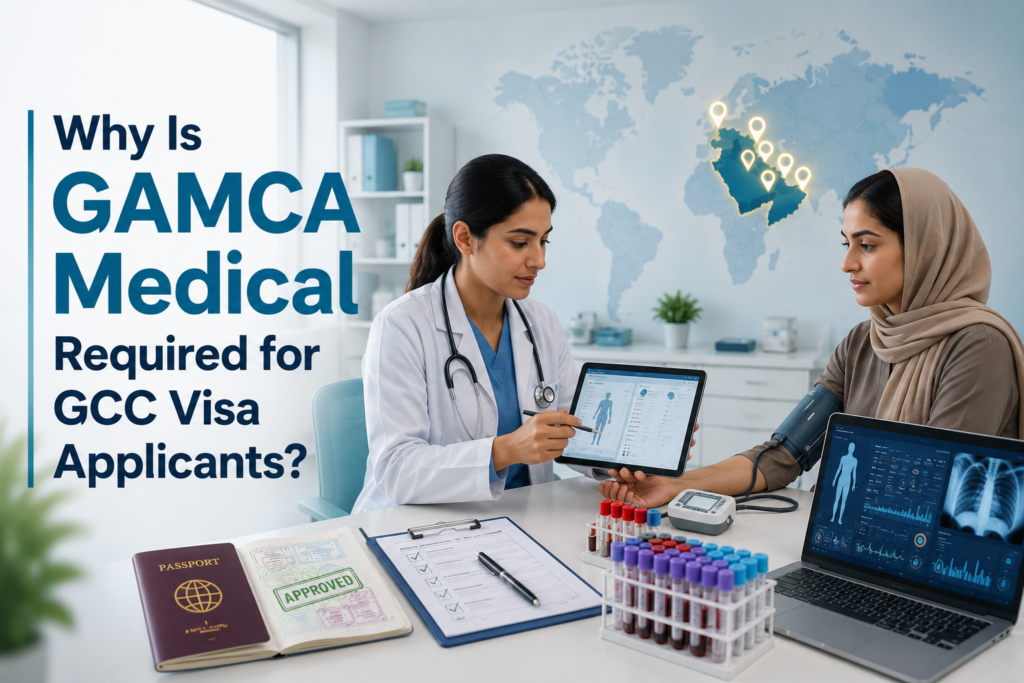
The question of why a medical examination is required before a visa can be issued is one that many first-time GCC visa applicants ask. The answer lies in the specific public health, employment, and immigration policy objectives of GCC member states — objectives that make the GAMCA medical clearance system not just a bureaucratic requirement but a genuinely purposeful element of the international migration framework between South Asia and the Gulf.
Understanding why GAMCA Medical clearance is required — not just that it is required — helps applicants approach the process with the right perspective and the preparation that makes it proceed as smoothly as possible.
Public Health Protection in Host Countries
The primary rationale for mandatory pre-visa medical screening is the protection of public health in GCC host countries. Gulf states receive millions of migrant workers and their dependents each year, creating conditions in which communicable diseases — if left unscreened — could be introduced into host country populations at scale. The diseases specifically screened by the GAMCA system — tuberculosis, HIV, hepatitis B, hepatitis C, syphilis, and malaria — were selected precisely because they represent the communicable disease risks most relevant to international migration from the specific sending regions.
Tuberculosis, for example, remains significantly more prevalent in South and Southeast Asia than in GCC countries, making TB screening of incoming workers genuinely protective of host country populations. HIV and hepatitis screening protects both the host country population and serves the additional purpose of identifying affected individuals who may benefit from medical attention they were unaware they needed. The screening is comprehensive and purposeful.
Healthcare System Cost Management
GCC countries provide healthcare services to their resident foreign worker populations — either directly through public health systems or through mandatory employer-provided health insurance schemes that fund private healthcare access. This healthcare provision creates a significant financial commitment that GCC governments manage through pre-entry health screening. Individuals with serious chronic health conditions that will require expensive treatment are identified before entry, allowing host countries to manage their healthcare resource allocation appropriately.
This cost management rationale is particularly relevant for conditions that require ongoing, expensive treatment — such as HIV, active tuberculosis, or severe hepatic disease from chronic hepatitis. Pre-entry screening allows informed decision-making about visa issuance that would not be possible without systematic health information.
Employer Protection and Workforce Management
From the employer’s perspective, GAMCA medical clearance provides assurance that recruited workers are in good health and capable of performing their contracted work. Workers who travel to GCC countries on employment visas and are subsequently found to have undisclosed health conditions face potential deportation, and their employers face the costs of recruitment, training, and replacement. The GAMCA system reduces this risk by providing a pre-departure health baseline that protects both workers and employers.
For workers, this protection operates in both directions — the medical examination may identify previously undiagnosed conditions that the applicant was unaware of, creating an opportunity for treatment in their home country before departure. Workers who are genuinely fit for employment arrive and work successfully; those with health conditions requiring attention are identified before the significant disruption of post-arrival discovery.
What Conditions Can Affect GAMCA Medical Fitness
The GAMCA examination uses the health standards set by each GCC member state for visa admissibility. While specific requirements vary slightly between countries, the conditions that commonly result in medical unfitness include active pulmonary tuberculosis, HIV/AIDS, active hepatitis B or C with significant markers, advanced syphilis, and in some cases significant chronic conditions with substantial treatment requirements.
It is important to understand that many conditions do not result in unfitness. Controlled chronic conditions, treated previous infections with resolved markers, and a wide range of common health conditions do not affect fitness determination for GCC visa purposes. The GAMCA examination is not a comprehensive fitness-for-work assessment in the occupational health sense — it is specifically focused on the communicable disease and public health criteria established by GCC member states.
How Results Are Communicated and Used
GAMCA medical results are transmitted electronically through the secure GCC health data system directly to the immigration and consular systems of GCC member states. This digital transmission means that results are available to embassy and consulate officers when processing visa applications without requiring the applicant to physically carry or submit a medical certificate.
Fit results are recorded with the validity period during which the visa must be issued and the applicant must travel. Unfit results are communicated to the applicant with the specific reason for the finding, giving the applicant the information needed to understand their situation and explore any available options. The digital system ensures that results are not susceptible to tampering or forgery — a security feature that benefits both applicants and GCC authorities.
Validity Period and Repeat Examinations
GAMCA medical fitness certificates are valid for a defined period — typically three months from the date of examination, though this may vary by destination country. If an applicant does not obtain their visa within this validity period, or if travel does not occur within the validity window, a repeat examination may be required. Applicants should coordinate their medical examination timing with their visa processing timeline to avoid the need for repeat examinations.
Repeat examinations are also required for new visa applications even if a previous GAMCA medical was conducted — medical clearances are specific to individual visa applications and cannot be reused for subsequent applications. This ensures that the health information used for each visa application reflects the applicant’s current health status rather than a potentially dated assessment.
Choosing the Right GAMCA-Approved Centre
The selection of a GAMCA-approved medical centre can affect the efficiency and quality of the examination experience. Factors worth considering include appointment availability (some centres have longer waiting times than others), the centre’s facilities and capacity to conduct all required tests in a single visit, the clarity and efficiency of their reporting and digital submission process, and the overall patient experience — including waiting times, staff professionalism, and communication.
Choosing a centre based only on proximity or price, without considering these service quality factors, can result in a longer, more stressful examination experience than necessary. The examination itself is straightforward; the centre’s organisation and professionalism determine whether it is processed efficiently or with unnecessary delays and confusion.