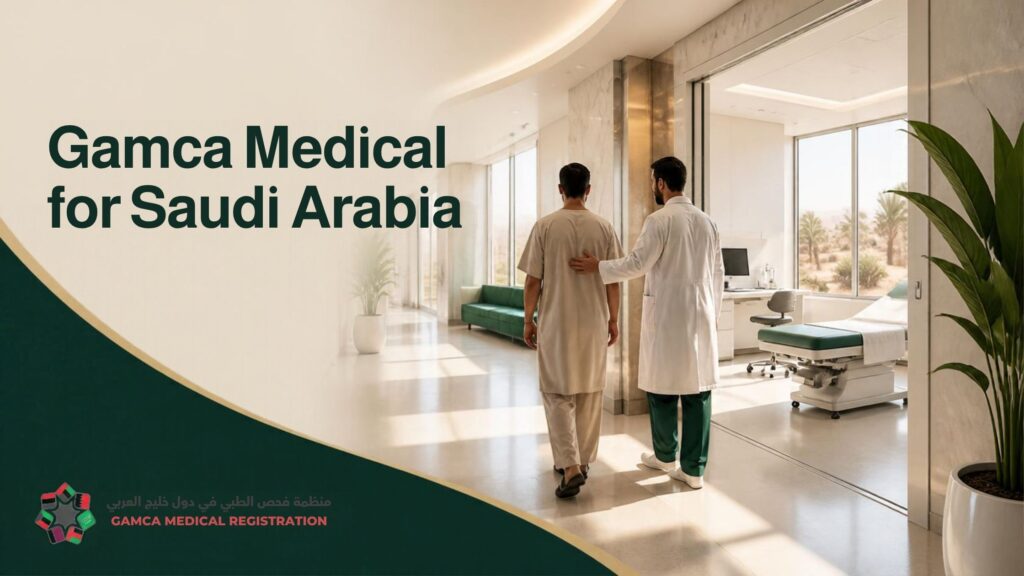
Saudi Arabia is the biggest employer of Indian workers in the Gulf. Riyadh, Jeddah, Dammam, Jubail and Madinah all hire in large numbers, and new projects keep opening roles in construction, healthcare, logistics, retail, tourism and technical services. For many people, a Saudi offer is the biggest career move of their lives.
It also comes with one of the more structured medical processes. If you’re preparing for Gamca Medical for Saudi Arabia, this guide explains the steps, the tests and the small details that decide whether your file moves smoothly or stops in its tracks.
Why the Saudi process is stricter
Saudi authorities treat the medical report as a firm requirement for visa stamping. The report is linked to your passport in a central system, and the embassy or visa service centre checks it before moving forward. A paper copy alone won’t help if the system doesn’t show your result.
That’s why accuracy matters more here. A wrong passport digit, a mismatched profession or a missing detail can leave your report sitting in the system without connecting to your visa file. Fixing it later takes time you may not have.
Who needs the medical
Almost everyone applying for a Saudi work visa from India is asked for it, whether skilled or unskilled. Drivers, nurses, technicians, engineers, domestic workers and hospitality staff are all included. Visit visas, family visas and special categories can follow different rules, so check with your sponsor or the visa agent.
Before booking, ask your recruiter for the exact profession printed on your visa and the destination to select. Taking the test under the wrong profession is one of the most common reasons for trouble.
What the tests cover
The Saudi medical follows the broader Gulf screening pattern. It begins with a general physical examination and a conversation about your health history and current medicines. Blood tests screen for infections such as HIV and hepatitis, as well as other markers like blood sugar. Urine is tested. A chest X-ray looks for tuberculosis and other lung conditions. Eyesight and hearing are checked, and women may be asked for a pregnancy test.
Some applicants may also be asked about vaccinations. Requirements can change, so ask your recruiter or the centre if any vaccination record is expected on the day.
Booking and attending
The booking process for Gamca Medical for Saudi Arabia is online. You open the official appointment page, enter your passport and personal details exactly as printed, choose Saudi Arabia as the destination country, select your profession, pick an approved centre and date, pay the fee, and download your slip.
On the day, bring your original passport, printed slip, photographs and photocopies. You’ll go through registration, sampling, X-ray and the doctor’s review. Most people spend two to three hours, though busy centres can take longer. The result is uploaded to the system afterwards, and you can ask your recruiter to confirm that it appears against your passport number.
Do not leave the centre without checking that your name, passport number and photo were captured correctly. If something looks wrong, speak up immediately.
Validity and timing
A Saudi medical report usually remains valid for a limited period, commonly about three months, but confirm the current rule before you book. Taking the test months ahead of the visa stage is a typical mistake.
A better plan is to get a clear timeline from your sponsor. When the visa application is ready to be lodged, schedule the medical so the report is fresh and visible in the system. If the visa is delayed, ask whether the existing report will still be accepted. Plan for the possibility of repeating it.
Reasons for delay or rejection
Administrative reasons cause more trouble than health reasons. Typing errors, wrong destination, profession mismatch, unpaid fees and uploaded data that doesn’t match the passport are the top culprits. Sometimes a centre’s upload is slow, and you simply have to wait.
On the health side, positive infection screening, an abnormal chest X-ray, uncontrolled blood sugar or high blood pressure can lead to a hold or an unfit result. In some cases a repeat test or doctor’s review resolves it. Ask for the reason, speak with your own doctor, and let your recruiter know early.
Keeping your health on track before the test
If you have a chronic condition like diabetes or high blood pressure, get it under control in the weeks before. Take your medicines regularly, avoid junk food, and don’t skip your doctor’s check-ups. A sensible routine lowers the chance of a bad reading on the day.
If you’ve had tuberculosis or hepatitis in the past, carry treatment records and discharge summaries. Honest documentation helps the doctor assess your case properly.
Protecting yourself from scams
Saudi visa processes attract fake agents. Be careful if someone promises a guaranteed visa, asks for money to “adjust” a result, or wants to collect your passport without explanation. Use official booking channels, keep all receipts, and ask for written confirmation of every fee.
A genuine report can only come from a genuine test. Anything else is risky, and the consequences, from visa cancellation to a travel ban, aren’t worth it.
Where the jobs are, and why it matters
Saudi Arabia’s big building projects, expanding healthcare system and growing tourism industry all need people. Engineers, nurses, technicians, drivers, cooks, retail staff and security teams are hired in large numbers. A few of those jobs have additional health or fitness expectations. A food handler, for example, may face extra checks for certain infections, and a driver may be screened for vision.
Ask your employer whether your role carries any special health requirement. It costs nothing to ask, and it prevents surprises.
Notes for women applicants and domestic workers
Women applying for jobs in healthcare, education, hospitality or household work follow the same process, with a pregnancy test usually included. It’s better to know this before you arrive at the centre. If you’re pregnant, tell the doctor and speak to your recruiter about timing.
Domestic workers often depend on agents to arrange paperwork. Even then, you should know your appointment date, the centre’s name and the profession entered on your application. Keep your own copy of the slip, and never let someone else attend the test in your place. If anything feels wrong, speak to a family member or a registered recruitment office.
Money matters: fees and small costs
Beyond the official fee, budget for travel, food, photographs, photocopies and perhaps one night’s stay if the centre is far from home. A small cushion for a repeat sample or follow-up visit can save stress.
Ask your employer or agent who pays for the medical, and get the answer in writing. In some cases it’s reimbursed, in others it’s deducted from the first salary. Knowing in advance prevents disputes.
Keep every receipt. If a payment issue or double charge occurs, those papers are your only proof, and they make it much easier for support staff to help.
A simple timeline for the day
Arrive at least thirty minutes before your slot. Register at the front desk with your passport and slip. Get your photograph and fingerprint taken. Move to sampling, where blood and urine are collected. Go for the chest X-ray. Meet the doctor for the physical examination and history. Collect any receipt or acknowledgement before leaving.
Most people are done in two to three hours, but allow a full morning in case the centre is crowded. Don’t book a flight or an important appointment on the same day.
A few quick answers
How soon should I ask about my result? Two or three working days after the test is reasonable. What if my name is misspelt? Tell the centre straight away, while the details are fresh. Can I use an old report? Only if your recruiter confirms that it’s still within the accepted validity window and matches your passport.
Can I take the test in a different city from where I live? Yes, as long as the centre is approved and you book it properly. Just plan travel and a place to stay if needed.
A note on patience
Gulf paperwork can feel slow, and you’ll often wait on others to act. Try not to panic or pay the first person who promises speed. Send polite follow-ups, keep a record of dates, and give each step a fair chance. Most files that look stuck are simply waiting for a signature or an upload, and a calm, well-timed reminder is usually all they need.
Final thoughts
Saudi Arabia offers real opportunities, and the medical is a hurdle that you can clear with preparation. Accuracy, timing and honest answers do most of the work.
Treat Gamca Medical for Saudi Arabia as a project with a checklist: correct details, approved centre, suitable date, tidy documents, and a follow-up to confirm the result shows in the system. Do that, and you’ll be one step closer to starting your job.