Why This Registration Matters More Than People Realise
Every year, lakhs of Indian workers head to the Gulf on employment visas, and almost all of them run into the same three letters at some point: GAMCA. If you’re one of them, you already know the medical clearance is non-negotiable. What most people don’t realise is that the process starts long before you walk into a test centre — it starts with getting your Gamca Registration sorted correctly online.
A rushed or incorrect registration is the single biggest reason candidates get delayed, sometimes by weeks. Wrong passport number, mismatched visa type, or a sponsor detail typed in a hurry — any of these can bounce your file back and cost you a slot you’d already paid for. So it’s worth slowing down and getting this part right the first time.
What GAMCA Actually Is
GAMCA stands for the Gulf Approved Medical Centres Association, a body formed by the health ministries of six Gulf Cooperation Council countries — Saudi Arabia, UAE, Qatar, Kuwait, Bahrain, and Oman — to standardise pre-employment medical screening for expatriate workers. Instead of every embassy running its own scattered checks, GAMCA-approved centres in India (and other labour-sending countries) carry out a fixed set of tests, and the result is shared electronically with the destination country’s immigration system.
This is why the test can’t be done at just any hospital. Only centres formally approved and listed under the GAMCA network are authorised to issue a report that Gulf authorities will actually accept.
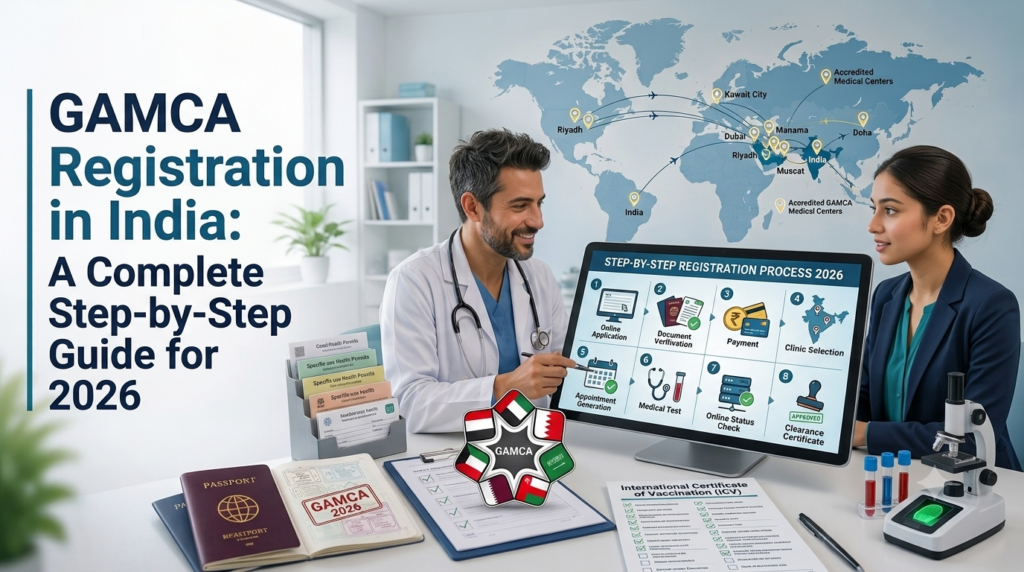
Step-by-Step: How the Online Process Works
1. Choose the destination country and visa type
Before anything else, you need your offer letter or visa reference handy. The portal asks for the country you’re travelling to and the category of visa (employment, family, visit, etc.), because the test panel can vary slightly by country and visa type.
2. Fill in your personal and passport details
This is the stage where most errors creep in. Your name, date of birth, and passport number must match your passport exactly — not your Aadhaar, not your old CV. Even a missing middle name can create a mismatch that delays your medical fitness certificate later.
3. Upload your passport-size photo and passport copy
Photos are usually rejected for having a coloured background, glasses, or a headscarf worn in a way that obscures facial features (religious headscarves that don’t cover the face are generally accepted, but check the specific country’s guidelines).
4. Select your preferred test centre and pay the fee
Fees vary depending on the destination country and are usually payable online via card or net banking. Once payment clears, you’ll receive a confirmation with a reference number — keep this safe, you’ll need it at the centre.
5. Book your appointment slot
Slots fill up quickly in peak recruitment seasons (typically before Ramadan and around the start of the Gulf financial year). Booking a day or two in advance rather than waiting until the last minute saves a lot of stress.
Documents to Keep Ready on Test Day
Original passport, printed appointment confirmation, four to six recent passport-size photographs, and — if applicable — your offer letter or visa copy. If you wear glasses or lenses, carry them; the vision test requires your corrected vision to be assessed too.
Common Mistakes That Cause Rejections
Spelling errors in the name field, an expired passport with less than six months’ validity, selecting the wrong destination country by mistake, and forgetting to declare an existing medical condition (which doesn’t automatically disqualify you, but hiding it can cause bigger problems if discovered later) are the top reasons applications get sent back.
How Long Does the Whole Thing Take?
From registration to receiving your medical report is usually five to seven working days, assuming no additional tests are required. If the doctor flags something in the X-ray or blood work, you may be called back for a repeat test, which adds time — one more reason to double-check everything before you submit.
Understanding the Fee Structure
Fees for the medical test are typically split into a registration/portal charge and a separate in-clinic testing charge, and the exact amount depends on which Gulf country you’re headed to. Saudi Arabia and UAE-bound applicants generally pay slightly more than those going to Oman or Bahrain, reflecting differences in the number of tests required. It’s worth asking your recruiting agency for the current fee schedule rather than relying on numbers you might have heard from a friend who travelled a year or two ago, since these figures are revised periodically.
Who Is Exempt From This Requirement
Not every traveller to the Gulf needs to go through this screening. Tourists, most business-visit visa holders, and short-term visitors are generally exempt, since the requirement is tied specifically to long-term employment and residency visas. If you’re unsure which category your travel falls under, your visa sponsor or the recruiting agency handling your paperwork should be able to confirm this before you spend time and money on an unnecessary test.
Frequently Asked Questions
Can I register on someone else’s behalf?
Generally, no. The portal requires the applicant’s own passport details and, in most cases, a live photo capture or an uploaded photograph that matches the passport, making it difficult to complete the process for another person without their direct involvement.
What if I make a mistake after submitting?
Some portals allow limited edits before payment is finalised. Once payment is processed, corrections usually require contacting the test centre directly or, in more serious cases, cancelling and re-registering, so it truly pays to review every field twice before hitting submit.
Is the process different for renewal or repeat travel?
Returning workers going back to the same country for a new contract typically go through the same registration steps as first-time applicants, since medical fitness certificates aren’t carried over between contracts and expire after a few months regardless of prior clearances.
A Quick Word on Choosing Where to Register
Because the process is entirely online before you visit the centre, it helps to register through a reliable portal that keeps your data secure and gives you clear, updated slot availability rather than outdated information. If you’d rather not navigate the government portal’s occasional glitches alone, platforms that specialise in Gamca Registration support can walk you through each field and flag errors before you submit.
How Recruiting Agencies Fit Into This Picture
If you’re travelling through a licensed recruiting agency rather than applying independently, they’ll often handle a good chunk of the registration steps on your behalf, or at least guide you through them closely. That said, it remains your responsibility to verify that the details entered match your passport exactly, since it’s your name on the visa file, not the agency’s. Never assume paperwork is correct just because someone else filled it in — a quick five-minute review on your end can save weeks of delay down the line.
What Happens to Your Data After Registration
A question many first-time applicants have is what happens to their personal and passport information once submitted. Reputable portals encrypt this data and share it only with the relevant destination-country medical and immigration systems, as required for visa processing. This is another reason it’s worth registering through an established, transparent platform rather than an unfamiliar third-party link shared informally through messaging apps or social media groups, which occasionally turn out to be unauthorised intermediaries.
Keeping a Personal Checklist
It helps to maintain a simple personal checklist alongside whatever your agency provides: passport validity date, destination country selected correctly, name spelling matched across every document, photograph specifications met, and payment confirmation saved somewhere safe. Ticking through this list right before you submit your form takes only a couple of minutes but meaningfully reduces the odds of a rejected or delayed application.
Planning Around Peak Season
Recruitment activity for Gulf jobs tends to spike around certain periods — post-monsoon hiring drives, the months before Ramadan, and the start of new Gulf fiscal or academic years for education-sector placements. During these windows, both registration slots and test centre appointments can book out faster than usual. If your travel dates are flexible, avoiding these peak windows can mean a noticeably smoother, faster process overall.
Final Thoughts
Getting your paperwork right the first time is the difference between a smooth departure and weeks of unnecessary back-and-forth. Treat the registration form with the same seriousness as your visa application — because in practice, that’s exactly what it is. Once your Gamca Registration is confirmed and your slot is booked, the rest of the journey to your Gulf job becomes a lot more predictable.